- Hivemind
- Posts
- Hivemind Times Issue #75
Hivemind Times Issue #75
Superbowl weekend: Learn about neutrinos while eating gravlax

Hivemind
February 06, 2026
In partnership with

Welcome To The Hivemind Times!
Happy Superbowl weekend my fellow sick freaks.
I am Graydon and this is the 75th Hivemind Times coming to you live on your computer screen. Well not really live for me, it is Thursday and I am in the back control room of the office watching 90s TV with my main man Tony.
We have been filming our asses off this week to stock pile some of the greatest content to ever hit Youtube so brace yourself. You should be receiving a beautiful and special Unlimited video today and we done peppered you with Cheap Seats content throughout the week.
This week's Times will be littered with fun time nuggets, good tunes, recipe for the big game, and maybe just maybe a little inspiration to power through the rest of this cold winter.
- Graydon
Where Expertise Becomes a Real Business

Kajabi was built for people with earned expertise. Coaches, educators, practitioners, and creators who developed their wisdom through real work and real outcomes.
In a world drowning in AI-generated noise, trust is the new currency. Trust requires proof, credibility, and a system that amplifies your impact.
Kajabi Heroes have generated more than $10 billion in revenue. Not through gimmicks or hype, but through a unified platform designed to scale human expertise.
One place for your products, brand, audience, payments, and marketing. One system that helps you know what to do next.
Turn your experience into real income. Build a business with clarity and confidence.
Kajabi is where real experts grow.
WEEKLY PLAYLIST
Disco House playlist curated and made for me by my dear friend Andy. He is a beast of a DJ and one hell of a Battlefield squad mate. The playlist was simply too good to keep to myself so if you need to make people dance now you have this fucker in the holster.
- Graydon

THE BEST SUPERBOWL SNACK
What are you choosing this Sunday? |
ALBUM RECS
Sometimes people who go to Berklee School of Music make some cool shit that isn’t jazz. This mf reanimated George Harrison's body and made his falsetto stronger. What a cool and exciting voice this guy has.
Spin the whole record and enjoy something that has truly infected me since its release.
- Graydon

QUINN’S CHEMISTRY CLASS
Neutrinos
One of my favorite topics to learn about in my free time is particle physics, so I’m going to write up a basic explanation of neutrinos for the sole purpose of showing you the inside of this neutrino detector in Japan called the Super Kamiokande, because it looks really really insanely cool. Also, this really annoying guy at a train station told me that neutrino detectors are used by the government as directed earthquake weapons to create earthquakes wherever they want, so that reminded me of them.
That earthquake thing is obviously not true by the way (they are basically really complex and big cameras), that guy was on another level dumb and said a bunch of other insane shit to me.
Neutrinos are elementary particles, meaning they are fundamental subatomic particles with no known internal structure (unlike protons or neutrons which are composed of quarks).
In this sense, they are comparable to electrons. The key difference is that electrons carry a negative electric charge, while neutrinos have no electric charge at all. Neutrinos are also extraordinarily light: their mass is less than about four millionths of an electron’s mass. For comparison, even the electron itself is very light, weighing only about 1/1837 as much as a hydrogen atom.
According to the Standard Model of particle physics, all matter is built from two main classes of elementary particles:
Hadrons experience the strong nuclear force, which binds quarks together inside protons and holds protons together within atomic nuclei.
Leptons, on the other hand, do not interact via the strong force. Neutrinos belong to the lepton family, just like electrons. They only interact via the weak force and gravity. Due to their extremely low mass and very short distances required for the weak force to interact, this means they hardly ever interact with anything.
The idea that neutrinos exist arose from studies of a radioactive process known as beta decay, in which a nucleus emits either an electron or its antimatter counterpart, a positron. Scientists noticed that the emitted electron did not account for all the energy lost by the nucleus during the decay. In 1930, the Austrian theoretical physicist Wolfgang Pauli proposed that this missing energy was being carried away by an unknown, electrically neutral particle produced at the same time. Several years later, the Italian-American physicist Enrico Fermi gave this hypothetical particle the name “neutrino,” a term that has remained in use ever since.
Because neutrinos interact extremely weakly with matter, they are notoriously hard to observe—a fact that initially led Pauli to worry they might never be detected at all. This changed after World War II, when nuclear reactors became available and provided an intense source of neutrinos.
In 1955, Fred Reines and Clyde Cowan successfully detected neutrinos using a process known as inverse beta decay. In this reaction, a proton absorbs an antineutrino rather than emitting one, producing a neutron and a positron (an electron with a positive charge). The researchers observed the positron when it annihilated with an electron, and detected the neutron when it was later captured by a nucleus. Seeing both signals together confirmed that the events were caused by neutrinos rather than cosmic rays (high-energy subatomic particles from space that are constantly bombarding Earth) or other background sources.
Neutrinos are among the most abundant particles in the Universe, likely ranking second only to photons. Depending on the nature of dark matter, they could even be the third most common type of particle overall. Enormous numbers of neutrinos were created in the moments following the Big Bang, and cosmological models predict that more than 300 neutrinos per cubic centimetre still fill all of space. Stars are another major source of neutrinos: the Sun alone sends around 65 billion neutrinos per square centimetre per second through Earth. Violent cosmic events such as supernova explosions and interactions involving cosmic rays also generate large numbers of neutrinos.
Neutrinos are also produced naturally by radioactive materials on Earth, including carbon-14, which is used in radiocarbon dating, and potassium-40. Additional neutrinos are created when cosmic rays collide with molecules in Earth’s atmosphere. Humans can also generate neutrinos using nuclear reactors and particle accelerators. These artificial sources rely on the same basic processes found in nature: neutrinos from reactors arise from radioactive beta decay, while accelerator-produced neutrinos are created through the same mechanisms as those from cosmic rays, but under carefully controlled conditions.
For any object to be detected, it must interact with the detector in some way. Human vision works because light particles, or photons, are absorbed by the rod and cone cells in the retina. Glass appears transparent because it does not absorb visible photons. Neutrinos, however, interact with matter extraordinarily weakly, which makes them extremely difficult to observe. In fact, to be almost 100% sure that a neutrino produced by the Sun would interact, it would need to pass through roughly a light-year of solid lead.
Luckily, particle interactions are governed by probability. While it might take a light-year of lead to stop almost every solar neutrino, a small number will still interact within the first inch. By using a detector that is large enough and exposing it to a very intense stream of neutrinos, a measurable number of interactions can be observed, even though 99.99999% of the neutrinos will pass straight through without any effect.
Neutrinos can interact with matter in two main ways:
They can scatter off an electron or an atomic nucleus. In this case, the neutrino remains a neutrino, but it transfers some of its energy and momentum to the particle it strikes.
They can convert into a charged lepton (an electron, muon, or tau (or their corresponding antiparticles)), depending on the neutrino’s type. This process involves not only the transfer of energy and momentum, but also electric charge, since neutrinos are electrically neutral while charged leptons are not.
In scattering interactions, detection usually comes from observing the recoiling particle, which may start moving or occasionally break apart. In conversion interactions, scientists typically detect the newly created charged lepton, though sometimes the change in electric charge of the struck material itself is observed. There are several ways to detect charged particles in motion: they can be tracked as they ionize atoms along their path, or they can be observed through the light they emit when traveling faster than light can move through a medium. This light is known as Cherenkov radiation, named after Pavel Cherenkov.
The Super-Kamkiokande in Japan uses Cherenkov radiation to detect neutrinos produced by the Sun. It is located 1000 meters underground, consisting of a 136ft tall and 129ft in diameter cylindrical steel tank holding 55 tons of ultrapure water with 11,146 photomultiplier tubes mounted to the walls.
It looks fucking AWESOME:
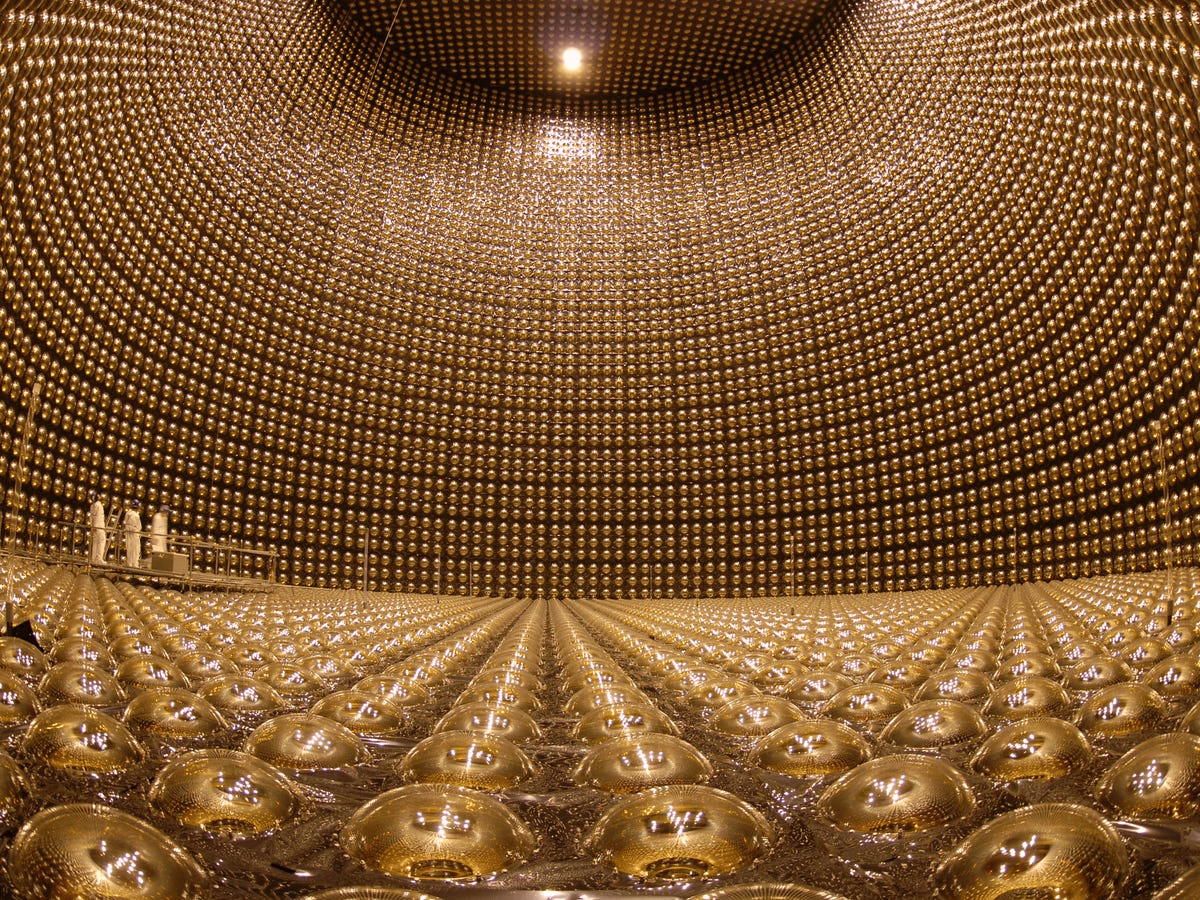


- Quinn
POEM OF THE WEEK
Wilfrid Wilson Gibson (1916)
Breakfast
We ate our breakfast lying on our backs,
Because the shells were screeching overhead.
I bet a rasher to a loaf of bread
That Hull United would beat Halifax
When Jimmy Stainthorpe played full-back instead
Of Billy Bradford. Ginger raised his head
And cursed, and took the bet; and dropped back dead.
We ate our breakfast lying on our backs,
Because the shells were screeching overhead.
RECIPES
Gravlax (Cured salmon)

Ingredients:
1 lb sushi-grade salmon, skin-on and boneless
1/4 cup coarse salt
1/4 cup white granulated sugar
Optional additions:
1/4 cup chopped fresh dill
1 tsp black or white pepper
Zest of 1 lemon or orange
Instructions:
1. Combine the salt, sugar, and any optional additions in a bowl and mix well.
2. Lay out a long piece of plastic wrap and spread half of the curing mixture into the shape of your salmon fillet.
3. Place the salmon on top of the mixture, skin-side down. Spread the remaining curing mixture evenly over the top.
4. Wrap the salmon tightly in the plastic wrap.
5. Place the wrapped salmon in a baking dish and top it with a weight (another baking dish or a cutting board with one or two canned goods works well).
6. Refrigerate for 24-48 hours (I recommend 36 hours for a medium cure), flipping the salmon every 12 hours.
7. Remove the salmon from the plastic wrap, rinse with cool water, and pat dry.
8. Refrigerate the salmon uncovered for 1 hour.
9. Slice thinly on a bias, being careful not to cut through the skin.
10. Serve! For an easy appetizer, try a cracker or potato chip topped with cream cheese, gravlax, capers, pickled red onion, and dill.
- Graydon


